Blog
Insurance
The hidden tax in insurance: non-claims “wasted time” (and how to get it back)
By
Richard He
Updated:
October 08, 2026
5 mins read

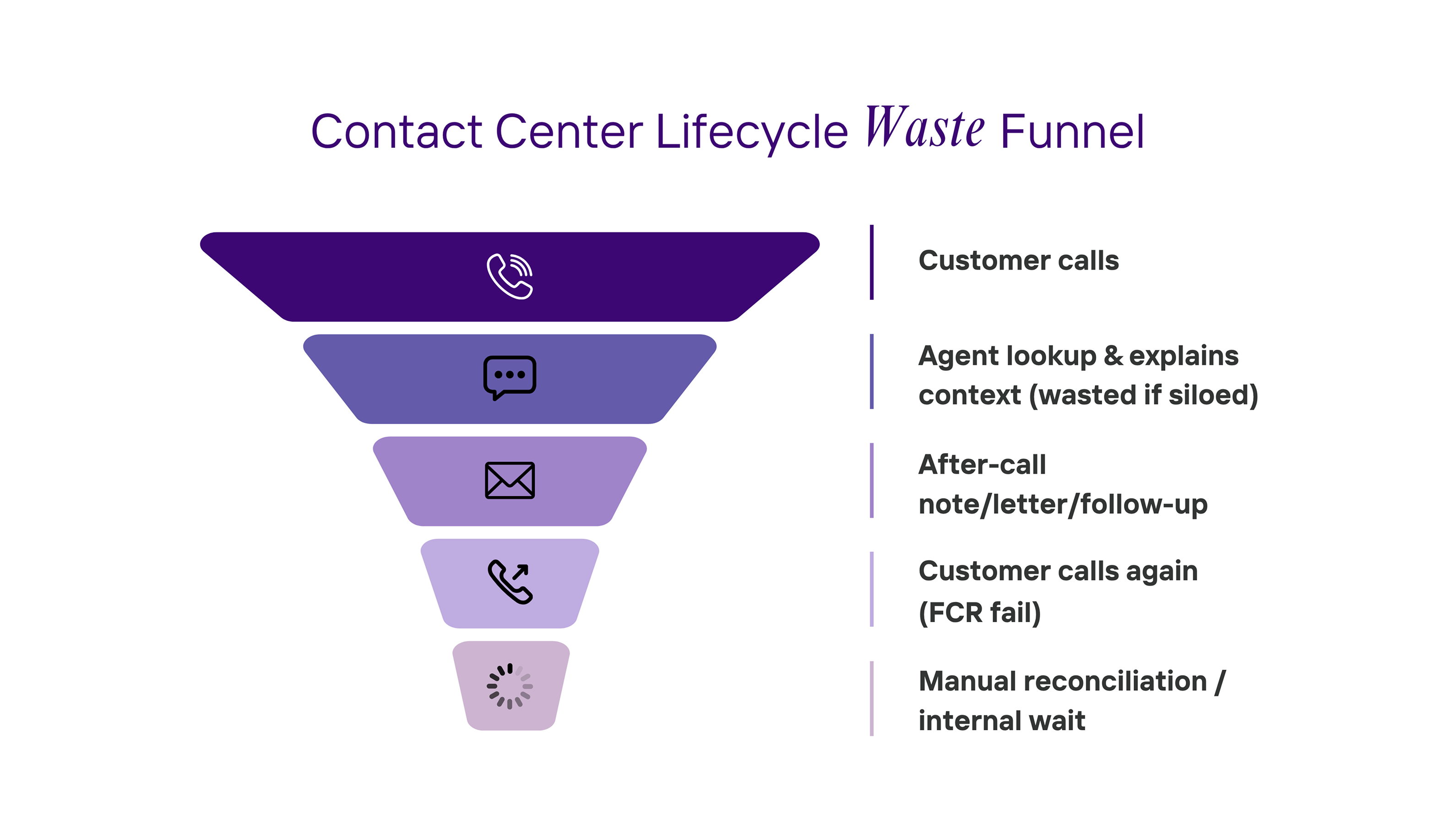
Insurance operations leak value long before a claim is adjusted. The biggest drains live in non-claims work: contact centers (policy/billing/status), policy servicing, endorsements, agent/broker support, directory compliance, and third-party verification calls. The pattern is consistent: repeat contacts, after-call busywork, manual chase work, and waiting for internal responses.

A few grounding facts:

  • Turnover is brutal: Contact centers average 30–45% annual attrition. Replacing agents is expensive and the quality drift is real. (TechRepublic)
  • Customers re-contact a lot: Average first contact resolution (FCR) across industries is ~69% — meaning ~31% of issues trigger at least one extra call. (SQM Group)
  • Calls are not short: Benchmarks put average handle time ~6 minutes (and insurance often runs longer). (Sprinklr)
  • ACW (after-call work) piles up: published ranges cluster around ~45–90 seconds per call (and can be minutes for complex billing). (VoiceSpin)
  • Insurance employs a lot of CSRs: BLS shows ~130k CSRs inside carriers and ~155k in agencies/brokerages (NAICS 524), with $22–$23/hr average wages — a large, ongoing spend. (Bureau of Labor Statistics)

What that implies (illustrative math): If a CSR handles ~75 customers/day at ~6.1 min each, and 31% of those are repeat contacts (because FCR=69%), that’s ~2.36 hours/day burned on avoidable repeats — ~615 hours/year per agent. At typical insurance CSR wages, that’s ~$13.7k–$14.2k per seat per year just from repeat contacts — before any ACW reduction. (eCommons)

Add a realistic 50% cut to ACW (e.g., AI-filled notes/templates), and you can free another ~122–244 hours/agent/year (≈ $2.7k–$5.6k). (VoiceSpin)

Where the time goes (non-claims)

1) Contact Center (Policy / Billing / Status)

Wasted time drivers

  • Repeat contacts because info lives in multiple systems or the first agent didn’t have authority/context (FCR avg ~69%). (SQM Group)
  • After-call work: note-taking, coding, disposition, letter/email drafting — often 45–90 sec per call and higher for complex billing. (VoiceSpin)
  • Talent churn → constant ramping, QA variability (attrition 30–45%). (TechRepublic)

Why this matters economically

  • There are hundreds of thousands of insurance CSRs across carriers and agencies; wages run ~$22–$23/hr. That’s billions in labor before tech, telephony, or vendor costs. (Bureau of Labor Statistics)

Extra pressure points

  • Healthcare contact centers report long hold times (e.g., 4.4 min avg vs. ~50 sec target) — a sign of structural mismatch between volume and staffing. (Dialog Health)

2) Policy Servicing, Endorsements & Billing Ops

Wasted time drivers

  • Manual reconciliations and after-call documentation (same dynamics as above). (Sprinklr)
  • Underwriter/ops wait time: in agent/broker channels, >50% of producers still need live carrier help for quoting/checking status, and nearly half report >2 hours to hear back from underwriting — stalling sales and prompting repeat contacts. (glia.com)

3) Agent/Broker Support Desk

Wasted time drivers

  • Producers ping carrier desks for underwriting clarifications, commission/licensing issues, or claim status when portals are incomplete. Over half still need live support frequently. (glia.com)

4) Healthcare Plan Back-Office: Provider Directory Verification (NSA 90-day rule)

Wasted time drivers

  • Plans must verify directory entries every 90 days and update within 2 business days — recurring, clerical chase work. (Centers for Medicare & Medicaid Services)
  • Despite the rule, inaccuracies persist; one study found errors lingering 540+ days for ~40% of sampled providers — implying constant rework. (AJMC)
A simple, transparent waste model (contact center)

Inputs (from research):

Illustrative outputs (per seat/year):
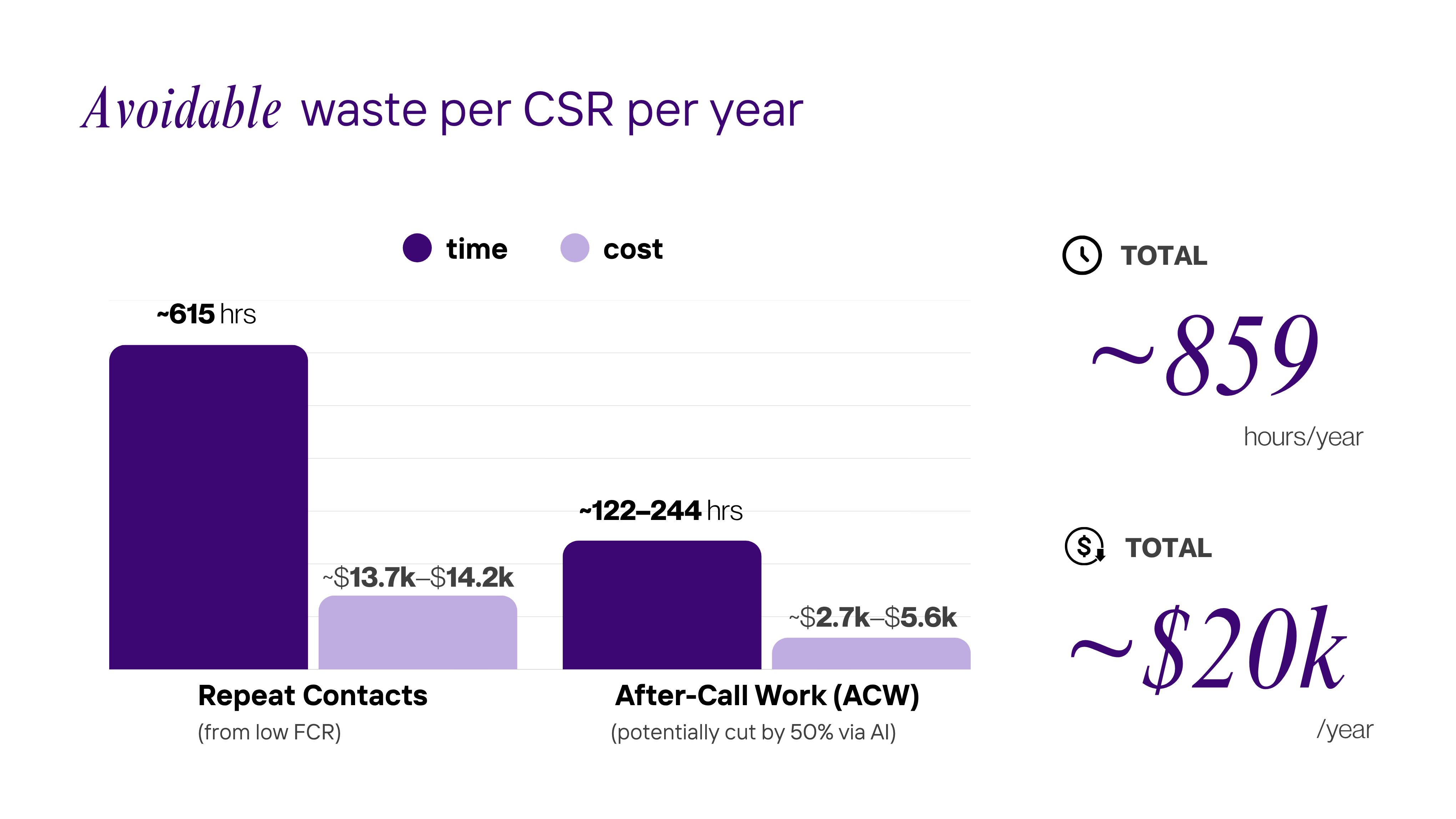
  • Repeat-contact waste: 0.31 × 75 × 6.1 min = ~2.36 hours/day~615 hours/year~$13.7k–$14.2k in labor. (SQM Group)
  • ACW reduction (50% cut): saves ~122–244 hours/year~$2.7k–$5.6k. (VoiceSpin)

Takeaway: The “non-claims tax” in policy/billing/status work is five figures per agent per year in avoidable labor — even before considering attrition backfill, QA leakage, or dissatisfied members calling again.
Why this persists
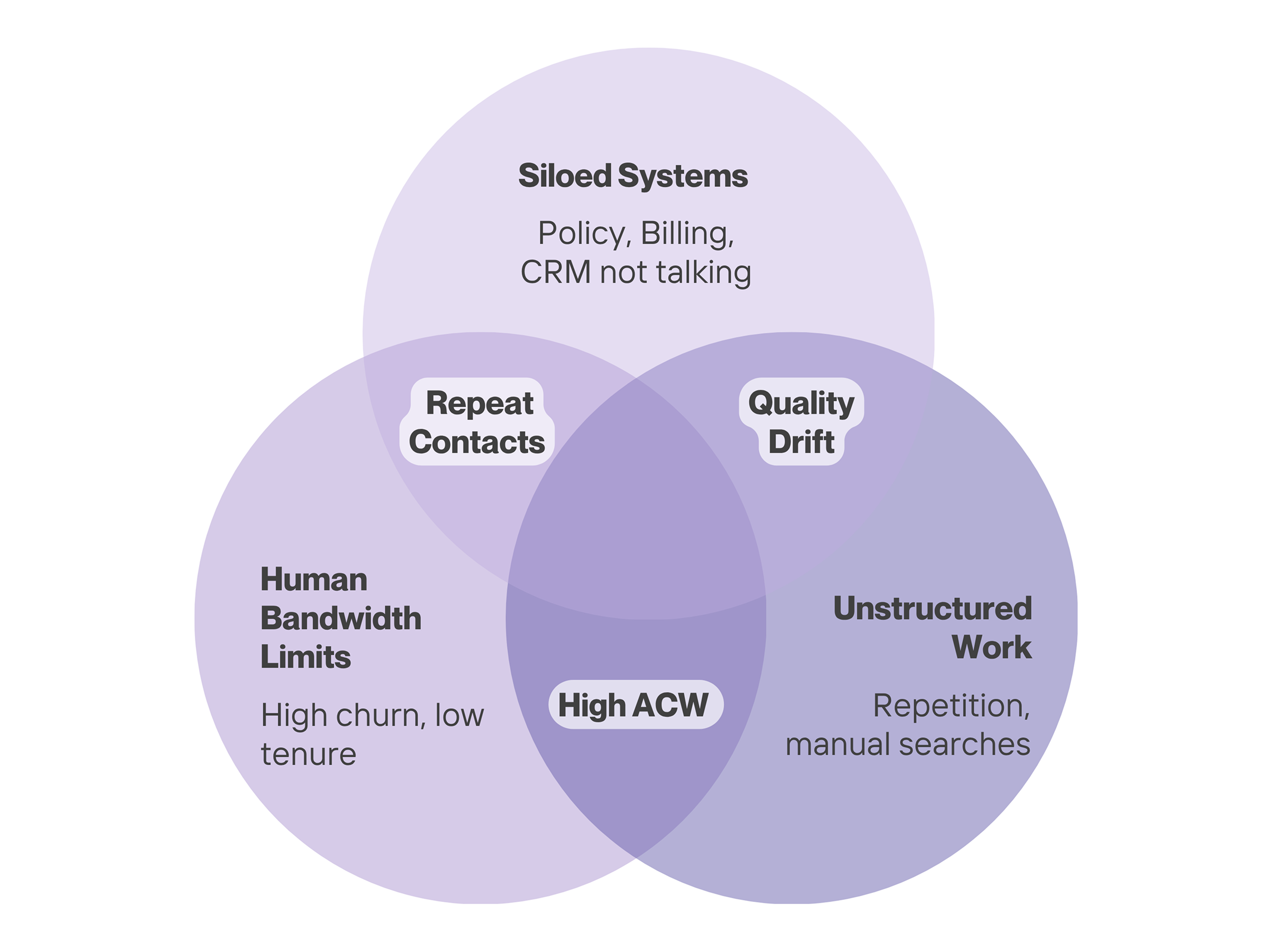
  • Siloed systems: Policy admin, billing, CRM, and claims notes don’t share context → agents ask customers to repeat themselves.
  • Human bandwidth limits: High churn (30–45%) keeps average tenure low, so knowledge resets often. (TechRepublic)
  • Unstructured work: Knowledge workers lose time to search/context-switching; McKinsey found 20–25% productivity upside from better collaboration/knowledge tooling — exactly the gap AI can close in service ops. (McKinsey & Company)

Related, routine, high-waste use cases you can tackle now
  • Agent/Broker support (quote status, underwriting Q&A, licensing/commissions): high frequency, repeat contacts. (glia.com)
  • Provider directory verification (NSA 90-day): constant attestations/updates with persistent errors. (Centers for Medicare & Medicaid Services)
  • Workers’ comp three-point contact (injured worker, employer, provider within 24–48h): many outbound calls, gatekeepers, and document chase. (Protective Insurance)
What “good” looks like (plain English)
  • AI answers and fills the forms; humans handle the tricky bits.
    • AI does the first pass: ID verification, policy lookup, billing actions, status pulls, structured notes, and compliant scripts.
    • Humans step in for edge cases (coverage gray areas, upset customers, complex billing disputes) and sign off on quality.
  • One-and-done design: Make it easy to solve on the first contact (FCR ↑), and auto-generate documents/updates so after-call work shrinks.
How AIBPO helps (and what we own)

AIBPO’s promise: We own the grunt work; you keep the decisions.

  • We run agentic pods (AI + AIBPO human specialists) for Contact Center (Policy/Billing/Status), Agent/Broker Support, Provider Directory 90-day verification, and Third-Party Verification Calls (providers, employers, shops, vendors, other carriers).
  • Our AI handles: omnichannel intake, compliant scripts, system lookups, drafting notes/letters, call retries & follow-ups, and queueing tasks.
  • Our people handle: refusals/gatekeepers, ambiguous or multi-party issues, policy interpretation edge cases, and quality sign-off.
  • Our deliverable: an audit-ready packet (structured fields + artifacts) and updates pushed into your systems — so your team can make the final decision without rework.

Why it pays back quickly (using the research above):

  • Cut repeat contacts (close FCR gaps) and ACW at the same time → $16–20k/CSR/year in labor reclaimed is common in our models (based on FCR, AHT, ACW benchmarks and BLS wages). (SQM Group)
  • Attrition buffer: moving routine work to AI reduces stressors that drive 30–45% churn. (TechRepublic)
Quick appendix — sources you can show your CFO
  • Attrition (30–45%): TechRepublic, SQM, Nextiva. (TechRepublic)
  • FCR average (~69%): SQM Group (2024–2025). (SQM Group)
  • AHT benchmarks (~6 min): Sprinklr round-up; Zendesk guidance. (Sprinklr)
  • ACW (45–90 sec typical; longer for complex): Voicespin; VCC; NICE. (VoiceSpin)
  • CSR employment & wages in insurance: BLS (NAICS 524: carriers & agencies/brokerages). (Bureau of Labor Statistics)
  • Agent/broker reliance on live help & slow UW response: Glia 2024 report. (glia.com)
  • NSA 90-day provider directory rule: CMS toolkits/FAQs; AMA summary. (Centers for Medicare & Medicaid Services)
  • Persistent directory inaccuracies despite the rule: AJMC study (2024). (AJMC)
  • Workers’ comp three-point contact standard: Carrier/TPA guidance (24–48h). (Protective Insurance)
Want us to quantify your waste?

We’ll plug your FCR, AHT, ACW, volumes, and wage data into the same transparent model to project savings by month/line of business — then stand up a 6-week lighthouse (top 4–5 inquiry types) to prove it in production.

What should you do next?
You made it till the end! Here's what you can do next to transform your operations:
Talk to an automation expert
30-min free consultation to assess your workflows and identify high-impact automation opportunities.
Find a time →
Explore AIBPO resources
You made it till the end! Here's what you can do next to transform your operations:
Explore more resources →
See AIBPO in action
Schedule a demo to see how AI-native agents automate your specific workflows—from FNOL to patient scheduling.
Book Demo →
Ready to Transform Your Operations?
See how AIBPO can automate your specific workflows. Schedule a demo to explore custom AI solutions tailored to your business needs.
Automate patient contact centers and scheduling
Accelerate claims processing and FNOL intake
Streamline medical coding and RCM workflows
Deploy AI agents in 4-6 weeks with measurable ROI
Trusted by leading healthcare and insurance organizations